
Can a Clean Title Still Hide Accident or Damage History?
Search Vehicle Report
Table of Contents
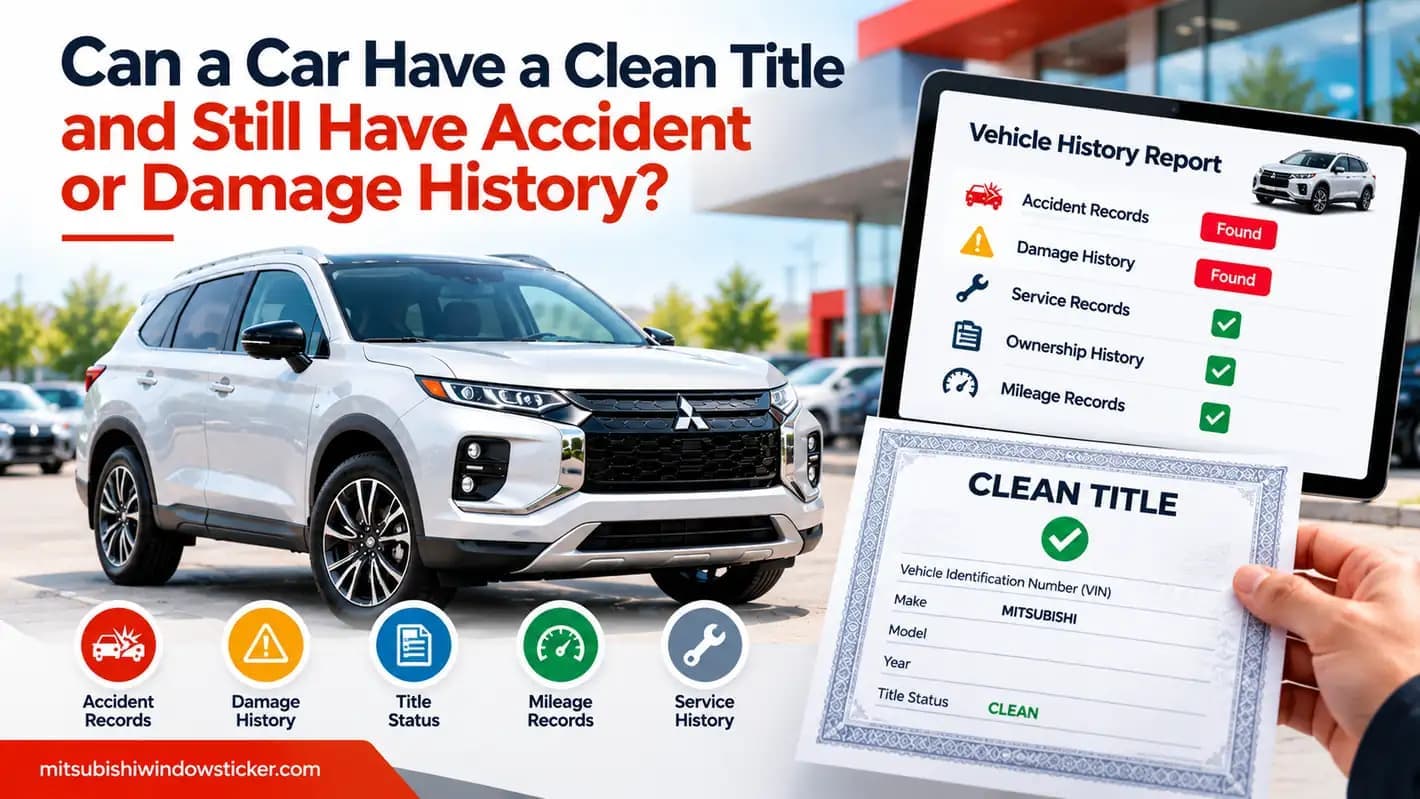
Yes. A car can have a clean title and still have accident or damage history. A clean title generally means the current title does not carry a major brand such as salvage or rebuilt. It does not certify that the vehicle has never been in a collision, repaired, or damaged.
This is very important when buying a used Mitsubishi. Title status answers one legal-record question while accident records, damage history, repair quality, and current condition answer different questions. Before you buy, check the exact VIN across those sources rather than treating “clean title” as a complete condition report.
Key Takeaways
 Clean title does not mean accident-free because a vehicle can be repaired after a collision and still retain an unbranded title.
- Title status and accident history are separate checks, and both need to be reviewed both before judging a used car.
- A vehicle history report can reveal recorded events, but it does not replace an independent inspection for hidden or current damage.
What Does a Clean Title Mean?
A clean title means a vehicle has no major title brands, such as salvage or rebuilt, recorded on its title. It suggests the car has not been officially classified as a total loss by an insurer or marked with certain serious damage records.
However, a clean title does not guarantee the car has never been in an accident, suffered damage, or undergone major repairs. Think of the title as one layer of the vehicle's story:
Source | Main Question it Answers |
Title record | Does the vehicle carry a title brand or other title-status issue? |
Vehicle history report | Are accidents, damage, ownership, mileage, or other historical events recorded? |
Repair/service records | What work was documented and when? |
Physical inspection | What condition is the car in now, and are there signs of previous repair? |
Why Can a Clean-Title Car Still Have Accident or Damage History?
An accident does not automatically produce a salvage or rebuilt title. Whether a title becomes branded depends on the event, applicable state rules, insurance or ownership circumstances, and how the vehicle was handled afterward.
The Damage Never Triggered a Title Brand
A collision can be repaired without the vehicle becoming salvage or rebuilt. Moderate body damage, bumper repairs, paintwork, glass replacement, or other repairs may never change title status. The title therefore remains clean even though an accident or damage event may appear elsewhere in the vehicle's history records for buyers.
The Vehicle Was Repaired Without a Total-Loss Decision
A car can sustain expensive damage and still be repairable rather than treated as a total loss. In that situation, the current title may remain unbranded. The buyer still needs to understand what was repaired, whether structural areas were affected, and whether the repair quality is acceptable today before purchase.
Some Damage May Be Paid for Outside Insurance
Not every repair goes through an insurance claim. An owner may pay directly for bodywork, glass, paint, or other damage. Those repairs can leave no title brand and may not appear in every history database. Physical inspection and repair documentation therefore remain important when the title looks clean before buying.
Different Records Capture Different Events
Title systems, insurers, repair facilities, auctions, and vehicle-history databases do not all capture the same information. One source may show a collision while another shows only clean title status. That difference is why buyers should compare records rather than treating a single clean result as the vehicle's complete history alone.
How to Verify a Clean-Title Car Before You Buy?
Use several sources in sequence. Start with the VIN and title record, then review accident or damage history, inspect the car itself, and use a pre-purchase inspection for issues that paperwork cannot confirm.
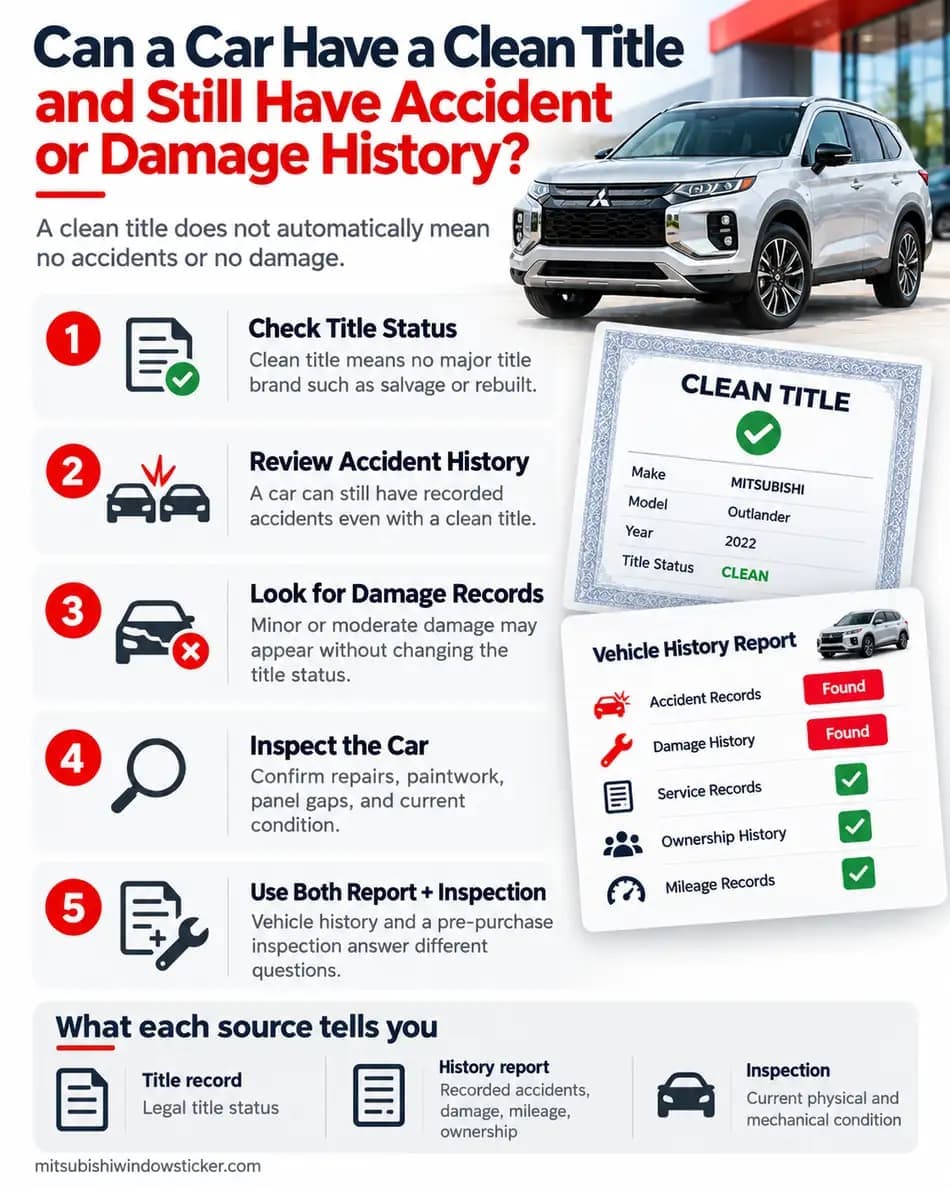
1. Match the VIN and Check Title Status
Start with the exact VIN on the dashboard, listing, and paperwork. Review current title status and available brand history for that VIN. If the seller says “clean title,” confirm what the record actually shows. A clean result is useful, but it should begin your verification rather than end it there.
2. Review Accident and Damage Records
Next, check available vehicle-history information for reported accidents, damage, insurance events, ownership changes, mileage entries, and auction or sales records when provided. Focus on dates, severity descriptions, and repeated incidents. Do not treat a blank field as proof that nothing happened; reporting coverage can differ between sources substantially for buyers.
3. Inspect the Car for Repair Evidence
Look closely at paint consistency, panel gaps, welds, fasteners, glass, lights, tires, suspension, and underbody areas. Uneven paint, overspray, misaligned panels, or unusual tire wear can justify a closer look. These signs do not prove unsafe repairs by themselves, but they identify areas that deserve professional inspection before purchase today.
4. Get an Independent Pre-Purchase Inspection
A pre-purchase inspection evaluates the car's present mechanical and physical condition, which title records cannot do. Ask an independent mechanic or qualified inspection service to examine previous repairs, steering, suspension, brakes, tires, warning lights, leaks, and structural concerns. Use the written findings when deciding whether to negotiate or walk away.
What a Vehicle History Report Can Help You Check?
A vehicle history report is useful because it brings several post-manufacture records into one review. A vehicle history report is described to include available reported accidents, title brands, thefts, lien records, ownership information, vehicle usage, auction and sales history, mileage records, and open safety recalls.
That makes it relevant to this exact question. A buyer can see a clean title status while also finding a recorded accident or damage entry in the same broader history review. To get a report for a ued Mitsubishi, use the Mitsubishi VIN check tool to analyse the VIN, but keep these two limits in mind:
- A report cannot confirm repair quality or current mechanical condition.
- If something was never reported to a data source used by the report provider, the generated report will not show it.
The strongest buying decision often combines records with the physical vehicle.
How Serious Is an Accident on a Clean-Title Car?
The word “accident” does not tell you enough by itself. A repaired bumper and a major structural repair should not be evaluated the same way. Use the available history and inspection to answer these questions:
- Where was the damage?
- Was it cosmetic, mechanical, or structural?
- Were airbags involved?
- Are repair invoices or photos available?
- Does the car drive straight and brake normally?
- Are panel gaps and paint consistent?
- Is there evidence of water intrusion or corrosion?
- Has the same area been repaired more than once?
If the history describes damage but provides little detail, the inspection becomes more important, not less.
Clean Title vs. Clean Vehicle History: What’s the Difference?
A clean title and a clean vehicle history are not the same. Understanding the difference helps you spot hidden risks and make a smarter decision when buying a used car.
Clean Title | Clean Vehicle History |
Means the title has no major recorded brands, such as salvage or rebuilt. | Means available records show no reported issues in the areas checked. |
Does not guarantee the car has never been in an accident. | May reveal reported accidents, damage, mileage issues, theft, and other events. |
Focuses on the vehicle's official title status. | Covers a broader range of available vehicle records |
May not reflect unreported accidents or repairs. | May miss accidents or damage that were never reported or recorded. |
A clean title does not guarantee a clean vehicle history. Before buying a used car, review its available history records and arrange a professional inspection to identify potential problems.
Can a Seller List a Car as “Clean Title” After an Accident?
Yes, if the vehicle's title is actually unbranded, the phrase “clean title” can accurately describe title status even when the vehicle has a separate accident record. The problem starts when buyers interpret the phrase as “never damaged.”
That is why the listing, title record, and history report should be compared instead of reading it in isolation. If the advertisement also claims “no accidents,” verify that claim separately.
This connects directly with another common used-car problem. So you need to know how to verify if a used car listing is wrong by confirming what originally came with the car with a window sticker. A listing is a seller's description; the VIN-linked records and the actual car are the evidence you use to confirm it.
Does a Clean Title Make a Former Rental Safer to Buy?
Not by itself. A former rental can have a clean title and still require the same checks for accident history, maintenance, mileage, wear, and current condition. If rental history is part of the vehicle's past, review it as another factor rather than assuming the clean title resolves it.
For instance, if you’re buying a former rental Mitsubishi, you should know what to check before deciding to buy the car. With this, you will understand how to combine rental-use history with maintenance records, inspection findings, and price comparison. A clean title is one positive data point. It is not a substitute for the rest of the used-car review.
A Typical Scenario
Imagine a used Mitsubishi is advertised with a clean title. The title record shows no salvage or rebuilt brand, but the vehicle history report contains one accident entry from two years earlier.
The seller provides a repair invoice showing replacement of a bumper cover and one headlamp. A pre-purchase inspection finds consistent panel alignment, no warning lights, normal tire wear, and no obvious structural concern in the inspected areas.
In that hypothetical case, the accident record does not automatically make the car a bad purchase. The buyer can evaluate the repair, condition, price, and documentation together.
Now change one detail: the inspection finds uneven panel gaps, overspray, steering pull, and damage around a structural mounting point. The clean title has not changed, but the buying decision should. The key lesson is that title status does not grade repair quality.
When a Clean-Title Car Deserves More Caution?
Slow down when the title looks clean but other evidence does not line up. Warning signs include:
- The seller avoids providing the VIN;
- Accident dates conflict with ownership or mileage records;
- Visible repairs are not explained;
- Panel gaps, paint, or tire wear look inconsistent;
- The seller refuses an independent inspection;
- The asking price does not reflect significant recorded damage; or
- The listing says “no accidents” while the history report shows one.
One mismatch may have a reasonable explanation. Several mismatches are a reason to investigate before paying.
What to Ask the Seller Before Buying?
Keep your questions specific and easy to verify:
- Has the car ever had body or collision repair?
- Are repair invoices or before-and-after photos available?
- Was any structural work completed?
- Were airbags replaced or repaired?
- Is the title currently branded in any state?
- Can I review the VIN-linked history report?
- Can I arrange an independent inspection?
- Has the asking price been adjusted for the recorded damage?
Get important answers in writing. If the seller's explanation changes after you show the records, reconsider how much confidence to place in the rest of the transaction.
Conclusion on if a Clean Title Can Hide Accident or Damage History
Yes, a car can have a clean title and still have accident or damage history. Clean title status mainly tells you about the title record. It does not certify an accident-free past, perfect repairs, or current mechanical condition.
Check the VIN, title and brand history, available accident and damage records, repair documentation, and the physical car. Then use an independent inspection to evaluate what the records cannot show.
When those pieces agree, you can judge the vehicle on evidence instead of relying on the words “clean title” alone.