
Buying a Former Rental Mitsubishi? Check These Before You Decide
Search Window Sticker
Table of Contents
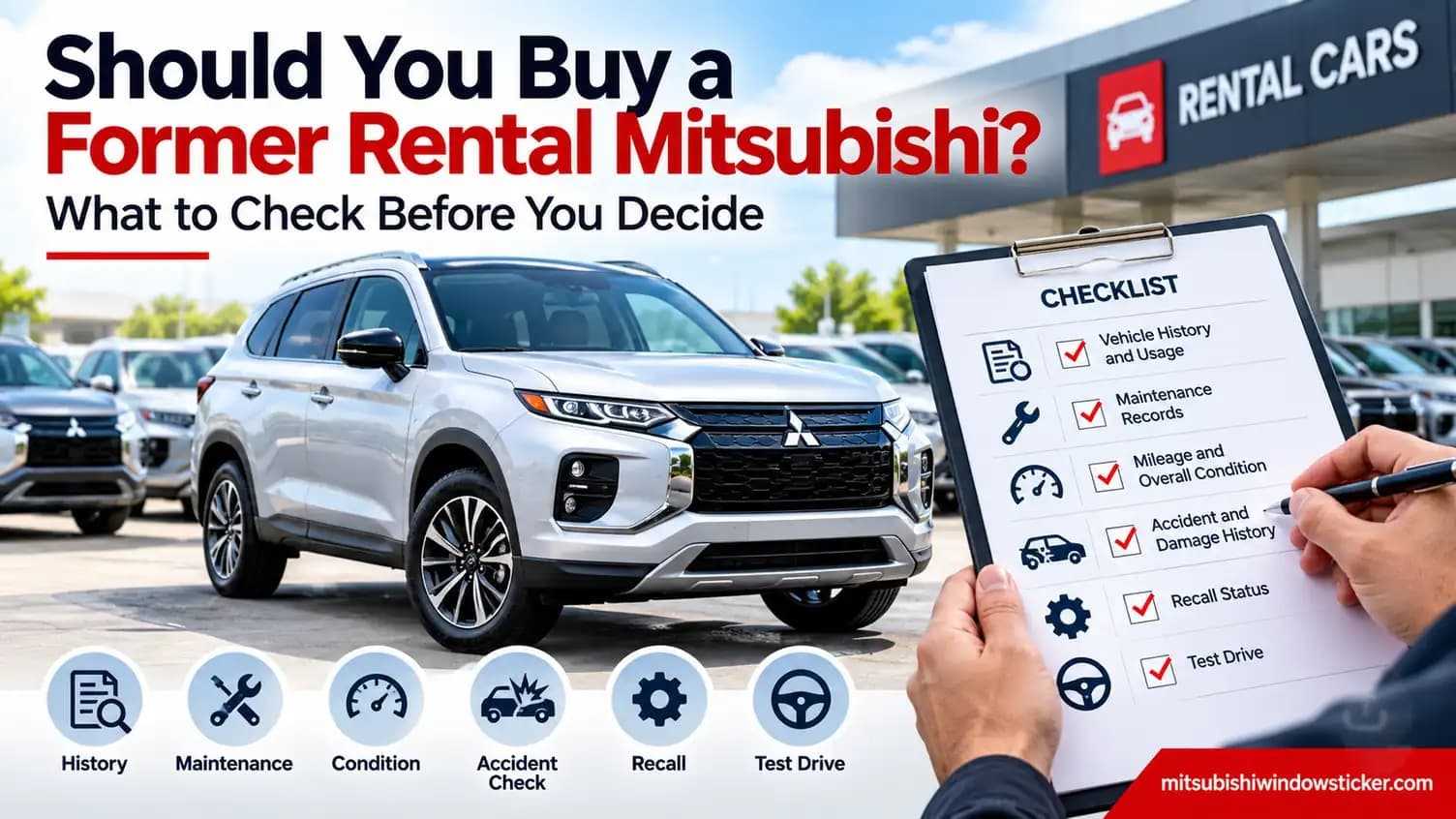
A former rental Mitsubishi can be worth buying, but rental history should make you verify the car more carefully, not reject it automatically. The right question is whether the price reflects the mileage, wear, service history, current condition, and remaining coverage of that exact vehicle.
A rental car may have had many drivers and accumulated miles quickly. It may also have received routine fleet servicing. Neither point proves the car is good or bad. Your decision should come from the records, the inspection, and how the vehicle compares with similar non-rental Mitsubishis.
Key Takeaways
 A former rental is not automatically a bad buy; condition and documentation matter more than the label alone.
- Check the Mitsubishi vehicle history, service records, mileage, accident or damage evidence, recalls, warranty terms, and current mechanical condition.
- Compare the price with similar non-rental vehicles. A lower price only helps if it reasonably compensates for the car's mileage, wear, and future repair risk.
Is a Former Rental Mitsubishi a Bad Idea?
Not necessarily. Rental history is a risk factor to investigate, not a verdict.
A rental Mitsubishi may have been driven by many people, used in unfamiliar conditions, and accumulated mileage faster than a privately owned car. On the other hand, some rental operators maintain fleet service schedules to keep vehicles available for use.
The problem is that neither assumption tells you what happened to the specific car in front of you. Some former rentals are clean, well-maintained, and sensibly priced. Others show excessive wear, incomplete records, previous damage, or a price that is too close to a comparable privately owned vehicle.
Former Rental vs. Privately Owned Mitsubishi
The ownership label changes what deserves attention, but it does not replace the usual used-car checks.
Factor | Former Rental | Privately Owned Used Car |
Driver count | May have many short-term drivers | Often fewer regular drivers |
Mileage pattern | Can accumulate quickly | Varies by owner and commute |
Service records | May follow fleet schedules | Depends heavily on the owner |
Interior wear | Can be higher from frequent turnover | Depends on care and use |
Accident/damage risk | Must be checked from records and inspection | Must also be checked |
Price | May be discounted | Depends on market and condition |
Best evidence | History, maintenance records, inspection, test drive | Same core evidence |
A former rental only becomes attractive when the price, records, and condition work together.
What to Check Before Buying a Former Rental Mitsubishi?
Use the same sequence for every candidate so one attractive price does not distract you from a missing record or mechanical problem. Start with history and maintenance, then move to the physical car and an independent inspection.
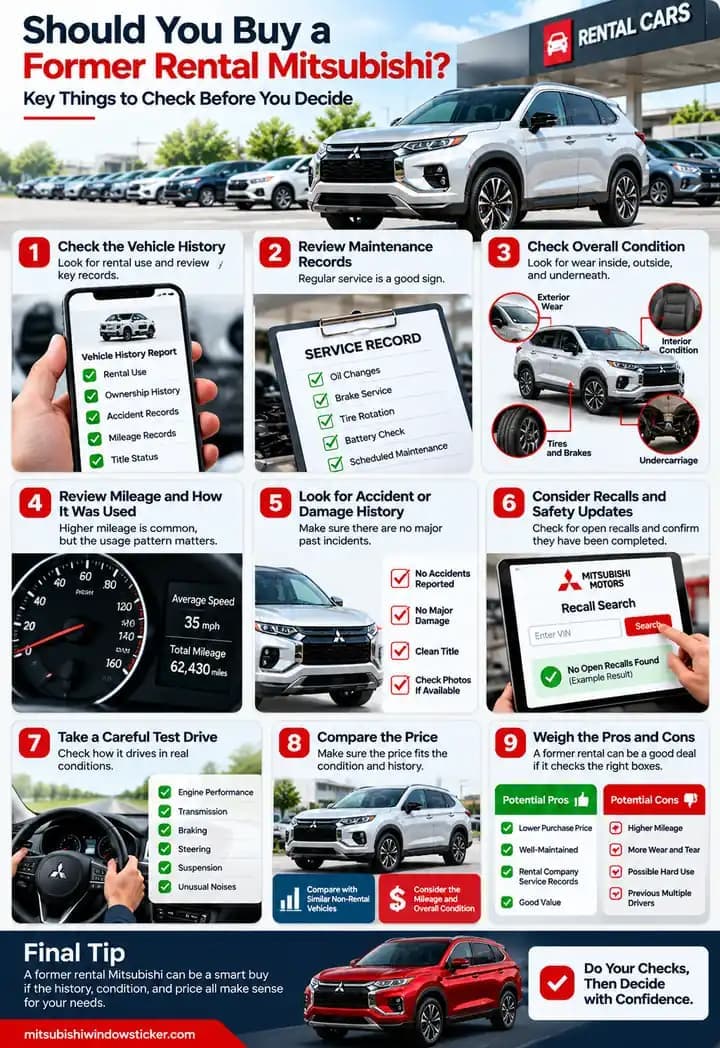
1. Check the Vehicle History
Start with the VIN and review available history records for rental use, title events, mileage entries, accidents, damage, and ownership changes. A Mitsubishi history report can reveal useful recorded events, but a clean report does not prove nothing happened. Treat it as one evidence source, then verify the car physically yourself.
2. Review Maintenance and Service Records
Ask for maintenance records showing oil changes, tire service, brake work, inspections, and other scheduled care. Consistent records are more useful than a seller simply saying the car was maintained. Look for unexplained gaps, especially during high-mileage periods, and carefully compare the service history with the vehicle's age and mileage.
3. Inspect Wear Inside and Outside
Check tires, brakes, wheels, body panels, paint, glass, seats, controls, cargo areas, and frequently touched surfaces. Rental use can create wear that mileage alone does not explain. Uneven tires, mismatched paint, damaged trim, odors, stains, or worn controls deserve closer inspection before you decide the asking price is fair today.
4. Get an Independent Pre-Purchase Inspection
Have an independent mechanic inspect the Mitsubishi before you buy it, even if the seller has already checked it. A vehicle history report cannot show every mechanical problem or hidden repair. Ask for findings and estimated repair costs, then use that information to decide whether to negotiate, proceed, or choose another vehicle instead.
What Rental History Can and Cannot Tell You
Rental history tells you how the vehicle was used, but not whether it is currently reliable. A report can help identify rental or fleet use, ownership periods, mileage entries, title information, and recorded accident or damage events. It cannot prove that every incident was reported, that every service was completed, or that the car is mechanically sound today.
A history report and an independent inspection answer different questions. The report can surface recorded events; the inspection can catch current mechanical or physical issues that never appear in a database.
This distinction matters for the next buying check too. A clean title does not automatically mean no accident or damage history. To understand better, you can see how a car can have a clean title and still have an accident or damage history.
Verify What the Mitsubishi Originally Came With?
Rental history tells you about use. Factory documentation helps answer a different question: how was this Mitsubishi originally configured? A Mitsubishi window sticker can help you review original trim, factory-installed packages, options, colors, and manufacturer pricing for the VIN.
That is useful when a used listing claims premium equipment or when you are comparing two similar vehicles. Do not assume that factory equipment is still present or working. Use the original record as the baseline, then confirm the current car.
Match the Exact VIN and Trim
Confirm that the VIN on the listing, dashboard, paperwork, and factory record matches the same vehicle. Then verify the trim rather than trusting badges or a generic listing description. Rental inventory feeds can contain mistakes, so a VIN-matched factory record gives you a stronger baseline for comparing equipment and price.
Compare Factory Equipment With the Car
Review the factory options, then check whether those features are still present on the Mitsubishi. Wheels, audio systems, floor mats, cargo equipment, or other items may have been changed during rental service. If a valuable option is missing or replaced, consider that difference when judging the vehicle's current value carefully.
Check Warranty Status Separately
Do not assume the window sticker proves remaining warranty coverage. The sticker can show original warranty information, but current eligibility depends on time, mileage, terms, and vehicle history. Ask the seller for current warranty documentation and confirm any remaining coverage before using warranty claims to justify a higher price today.
Compare the Asking Price With Similar Cars
Compare the former rental with Mitsubishi vehicles of the same model year, trim, drivetrain, mileage range, equipment, and condition. A discount is meaningful only when the comparison is equivalent. If the rental car costs nearly the same as a cleaner non-rental example, the ownership history may offer little financial advantage.
Mileage and Usage Pattern Matter
Higher mileage is common on some former rentals, but mileage by itself is not enough to accept or reject the car. Look at how quickly the mileage accumulated and what condition the car shows now.
Highway-heavy use can produce different wear from repeated short urban trips, parking-lot impacts, curb contact, and frequent passenger turnover. You usually cannot reconstruct every trip, so use the odometer together with maintenance records and physical condition.
Pay particular attention to:
- Tire age and evenness of wear;
- Brake condition;
- Suspension noises or looseness;
- Wheel and curb damage;
- Seat, carpet, and cargo-area wear;
- Steering-wheel and control wear; and
- Unusual rattles, vibrations, or warning lights during the test drive.
A high-mileage car with strong records and good condition may be a better buy than a lower-mileage car with poor maintenance and obvious neglect.
A Clean History Report Is Not Enough
A report with no recorded accidents is useful, but it should not end your inspection. Not every minor repair, scrape, dent, or bodywork event is guaranteed to appear in a history database. Look at panel gaps, paint consistency, lights, glass, wheel alignment, underbody condition, and signs of previous repair.
Ask the mechanic to look for structural or mechanical concerns that are not visible in an online record. This is especially important with a former rental because many drivers may have used the vehicle before you ever see it.
Check the FTC Buyers Guide and Warranty Terms
If you are buying from a U.S. dealer, you should review the FTC Buyers Guide displayed with the used vehicle. The FTC's used-car buying guidance shows whether the dealer offers a warranty or sells the vehicle under the applicable "as is" or implied-warranty terms.
Do not rely only on spoken promises. Confirm in writing:
- Whether the dealer provides a warranty;
- Which systems are covered;
- How long coverage lasts;
- What portion of repair costs is covered;
- Whether there is a deductible;
- Whether a separate service contract is being sold; and
- Whether any manufacturer warranty remains.
Keep warranty questions separate from the original factory window sticker. One describes original manufacturer information; the other determines what protection applies to the used car transaction now.
How to Test Drive a Former Rental Mitsubishi?
A test drive should answer more than "Does it move?" Use it to look for problems that paperwork cannot show. Drive at low and moderate speeds. Include turns, braking, acceleration, uneven pavement, and a short highway section when practical. If the drive raises a concern, do not let a lower rental-car price talk you out of investigating it.
Listen and feel for:
- Hesitation or rough shifting;
- Vibration through the steering wheel or seat;
- Brake pulsation or pulling;
- Suspension clunks;
- Steering that wanders or feels uneven;
- Abnormal tire noise;
- Warning lights; and
- Air-conditioning, cameras, sensors, screens, seats, and other equipment that do not work properly.
A Simple Buying Guide Sample
Suppose two similar Mitsubishi SUVs are available. This is a hypothetical comparison.
Item | Former Rental | Non-Rental Example |
Asking price | $21,500 | $23,000 |
Mileage | 48,000 | 36,000 |
Service records | Consistent | Partial |
Inspection | Needs tires soon | No immediate repair noted |
History | Rental use, no major issue found in available records | Personal use |
The rental saves $1,500 upfront, but new tires reduce part of that advantage. If the inspection is otherwise strong and the maintenance history is better documented, the former rental may still be reasonable. The point is not that rental cars are cheaper or better. The point is to compare the total condition-adjusted value, not only the asking price.
When a Former Rental Mitsubishi Can Make Sense?
A former rental may be worth considering when most of these conditions are true:
- The VIN and advertised trim match;
- Maintenance records are consistent;
- Mileage makes sense for the vehicle's age;
- The history does not reveal unresolved title or damage concerns;
- An independent inspection finds no major issue;
- Tires, brakes, suspension, and interior condition are acceptable;
- Warranty terms are clear; and
- The price is meaningfully competitive with similar non-rental vehicles.
The rental history should be reflected in your comparison, not ignored.
When You Should Walk Away?
A low price is not enough when important questions remain unanswered. Be cautious if the seller will not allow an independent inspection, cannot explain major record gaps, gives conflicting mileage information, minimizes obvious damage, or relies on vague promises instead of written warranty terms.
Also reconsider the deal when several smaller problems stack together. Worn tires, overdue maintenance, interior damage, weak service records, and a price close to non-rental alternatives can erase the reason for accepting the extra uncertainty.
Questions to Ask the Seller
Use a short checklist so you get comparable answers from different sellers:
- How long was this Mitsubishi in rental or fleet use?
- Are complete maintenance records available?
- Has any bodywork or accident repair been completed?
- Are there open recalls or unresolved service campaigns?
- What warranty applies today?
- Can I take the vehicle for an independent pre-purchase inspection?
- Are any accessories or factory features missing or replaced?
- What is the written out-the-door price?
Save the listing and the seller's answers before you visit. That makes it easier to compare what was advertised with what you actually find.
Conclusion On Buying a Former Rental Mitsubishi
A former rental Mitsubishi can be a sensible used-car purchase when the price is right, and the records, inspection, condition, and warranty support the deal. Rental history alone should not decide for you.
Verify the Mitsubishi VIN and original equipment, investigate the history, review maintenance, inspect the car carefully, and get an independent pre-purchase inspection. Then compare the total value with similar non-rental Mitsubishis. If the savings do not compensate for the mileage, wear, or uncertainty, keep shopping.