
Why Is the Dealer Price Higher Than the Window Sticker Price?
Search Window Sticker
Table of Contents
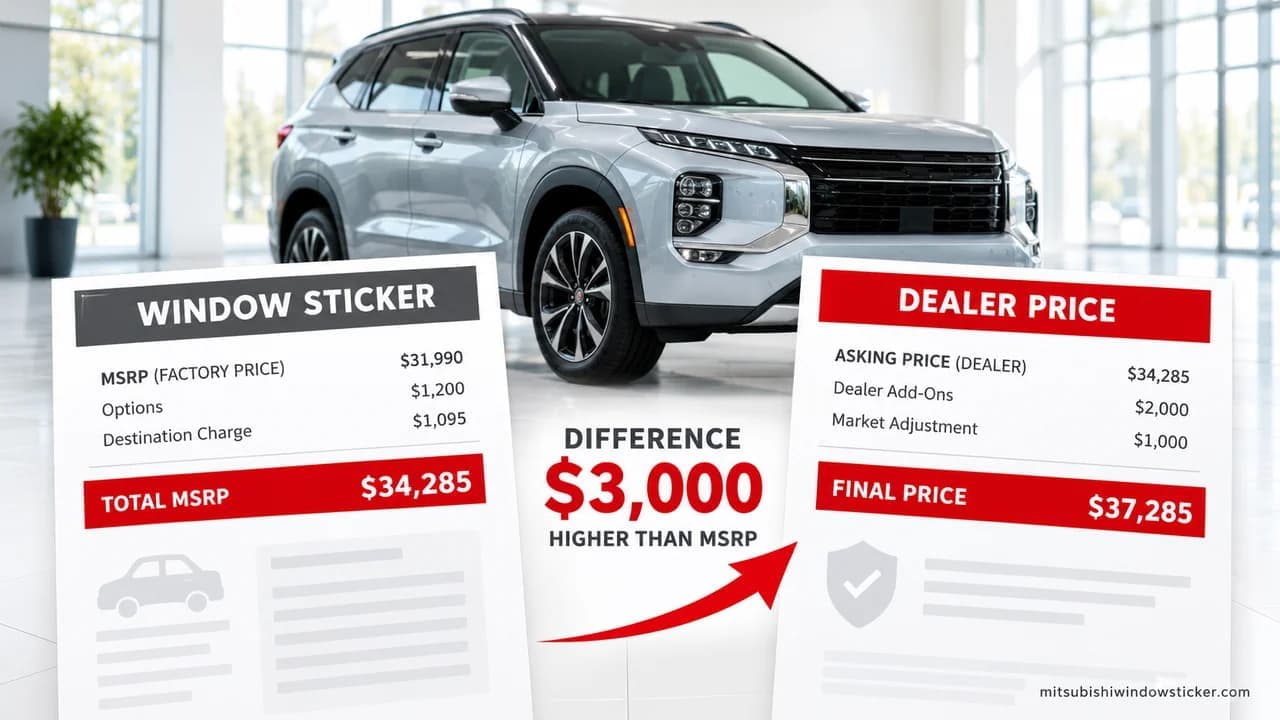
A dealer can ask more than the number printed on a vehicle’s factory window sticker because the two prices come from different stages of the sale. The window sticker price records manufacturer pricing for the vehicle as originally configured. A Mitsubishi window sticker gives you that factory baseline for the exact vehicle, while the dealer’s number reflects what that dealership wants for the car today.
The difference may come from a dealer markup, dealer-installed products, transaction charges, or current used-car pricing. The useful question is not simply “Why is it higher?” It is “Which part came from the manufacturer, and which part was added later?”
Key Takeaways
 A dealer price higher than MSRP does not automatically mean the factory sticker is wrong.
- A dealer addendum, market adjustment, or dealer-installed option can raise the asking price above the factory figure.
- Compare the exact VIN, factory pricing, dealer additions, and written out-the-door price before deciding whether the difference makes sense.
Window Sticker Price and Dealer Price Are Different Numbers?
The factory sticker answers a historical pricing question: how did the manufacturer price and configure this vehicle when it was new? The dealer quote answers a transaction question: what does this seller want for the vehicle now?
That difference matters because several numbers can appear around the same Mitsubishi.
Price Or Document | What It Represents? | Common Items Included |
Factory window sticker | Original manufacturer pricing and configuration | Base MSRP, factory options, manufacturer destination charge, suggested total |
Dealer addendum | Dealership additions | Accessories, protection products, appearance items, market adjustment |
Dealer asking price | What the seller wants for the vehicle | Dealer-selected selling price |
Out-the-door price | Broader transaction total | Selling price plus applicable taxes, title, registration, documentation, and disclosed charges |
Do not compare only the first and last numbers. Identify what belongs to the manufacturer, what belongs to the dealer, and what belongs to the transaction itself.
Four Reasons a Dealer Price Can Be Higher Than the Window Sticker
There is no single explanation for every price gap. A new vehicle may carry a markup or dealer accessories, while a used vehicle may simply be priced for today’s market. These four situations cover the most common reasons.
The Dealer Adds a Market Adjustment
Dealer-Installed Products Change the Price
A dealership may install tint, appearance packages, protection products, security equipment, or other accessories after the vehicle arrives. These dealer-installed options can increase the asking price and often appear on a separate dealer addendum. The factory sticker shows whether each item was original equipment or added later by the dealer.
Transaction Charges Raise the Amount Due
The number on the factory sticker is not always the amount needed to complete the purchase. Taxes, title, registration, documentation, and other disclosed dealer fees can raise the final amount. These charges should be reviewed separately from the manufacturer’s destination charge, which may already appear on the factory sticker itself.
A Used Vehicle Is Priced for Today
A used Mitsubishi does not have to sell near its original MSRP. Age, mileage, condition, local demand, inventory, and comparable listings all affect current pricing. The original sticker remains useful for understanding equipment and original positioning, but it should not be treated as a current valuation for a used vehicle.
Read the Price in Layers, Not as One Big Number
Start with the factory sticker, then look for a dealer addendum, and finish with the written out-the-door quote. Each document answers a different question. The factory sticker shows manufacturer pricing while the dealer addendum covers dealership-added products or adjustments. The final quote combines the selling price with applicable transaction charges.
To separate the first two documents more clearly, see the difference between a window sticker and a dealer addendum to understand what you’re actually paying for.
A $1,500 markup, a $1,500 accessory package, and $1,500 in taxes or registration can all raise the total, but they are not the same type of cost. Review each one separately.
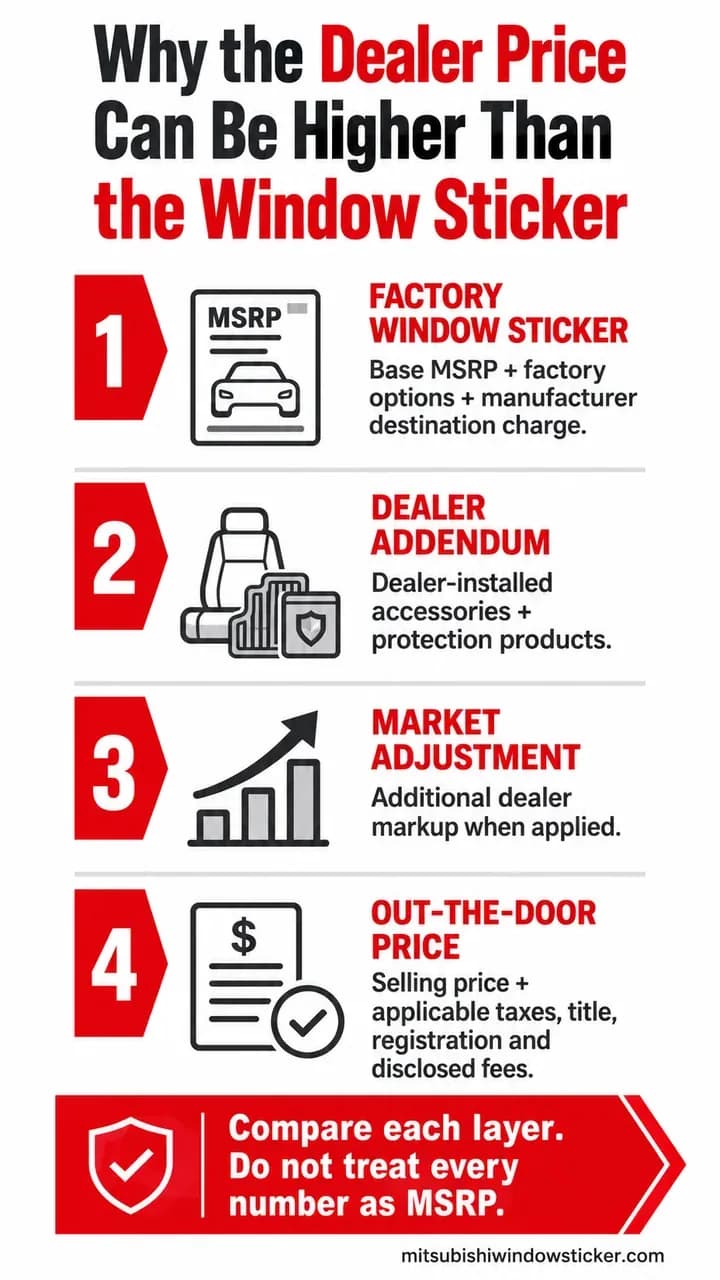
How to Check Whether the Higher Price Makes Sense?
You do not need to memorize every pricing term. Use the documents in order and make sure each new number has a clear source.
Match the Quote to the Exact VIN
Begin with the exact vehicle you are considering, not another example of the same model. Match the VIN on the dealer quote with the VIN on the factory information. Then check the original Mitsubishi MSRP so your comparison uses the correct trim, equipment, and original configuration before negotiating the final price.
Separate Factory Equipment From Dealer Additions
Read the factory equipment before reviewing the dealer addendum. If the same accessory appears in both places, ask how the dealer is pricing it. This comparison also helps distinguish manufacturer-installed equipment from tint, protection packages, security products, appearance accessories, or other items that were added after delivery to the dealership.
Request the Full Out-the-Door Price
Ask for the out-the-door price in writing rather than discussing only the monthly payment. A useful quote separates the selling price from dealer additions, taxes, registration, title, documentation, and other charges. Seeing those lines individually makes it much easier to challenge one amount without losing track of the total overall.
Compare Equivalent Vehicles, Not Just Headlines
Two Mitsubishi vehicles with the same model name can have different trims, drivetrains, packages, or factory options. Compare like with like before deciding one dealer is cheaper. If the equipment is different, the headline price difference may partly reflect configuration rather than a better or worse deal from the seller.
New and Used Cars Need Different Comparisons
For a new vehicle, the sticker is closely tied to the manufacturer’s suggested pricing. If the dealer asks more, the difference usually sits in the dealer’s selling price, a market adjustment, dealer-installed products, or transaction charges.
For a used vehicle, the sticker is better treated as historical evidence. It can confirm original trim, equipment, options, and pricing, but today’s asking price is shaped by age, mileage, condition, demand, and comparable listings. That is why the original MSRP should not be used as a current value by itself.
A Typical Mitsubishi Sticker Pricing Example
Suppose a Mitsubishi had a factory sticker total of $30,290. Now imagine the dealership adds a $1,500 market adjustment, an $895 protection package, and a $399 documentation fee.
This is a hypothetical example.
Pricing Layer | Example Amount |
Factory sticker total | $30,290 |
Market adjustment | +$1,500 |
Dealer protection package | +$895 |
Documentation fee | +$399 |
Example quote before taxes/title | $33,084 |
The extra $2,794 does not mean the factory sticker changed. It means the dealership added new pricing layers after the manufacturer’s original figure.
Here are questions that are more useful than arguing over one large total. These include:
- Is the markup acceptable?
- Is the protection package useful and fairly priced?
- Is the documentation fee clearly disclosed?
When Paying Above the Sticker Can Still Make Sense?
A price above the factory sticker is not automatically a bad deal. The extra amount may cover something you actually value, or the used-car market may have moved far from the vehicle’s original price.
Judge the difference by what created it:
- Useful dealer accessory: compare its price with the value you would place on the same item yourself.
- Market adjustment: compare equivalent vehicles at other dealers before accepting it.
- Used-car premium: check mileage, condition, equipment, and comparable listings instead of relying on original MSRP.
- Required transaction costs: confirm that taxes, title, registration, and disclosed fees are itemized correctly.
The important point is transparency. A higher price is easier to evaluate when every extra amount has a clear reason.
Watch for Charges That Look Similar but Are Not?
Some labels sound alike even though they come from different parts of the sale. That is where buyers can accidentally compare the wrong numbers.
Charge | Usually Comes From | What to Check |
Destination charge | Manufacturer | Whether it is already shown on the factory sticker |
Dealer delivery/preparation fee | Dealer | Whether it is a separate disclosed charge and what it covers |
Market adjustment | Dealer | Whether it is clearly separated from MSRP |
Documentation fee | Dealer | Whether it appears once and is included in the written quote |
If two charges appear to cover the same thing, ask the dealer to explain the difference before signing.
What the Window Sticker Can and Cannot Settle?
A factory sticker is strong evidence for original configuration and manufacturer pricing. It is not a complete explanation of today’s deal.
What the Window Sticker Can Confirm | What It Does Not Establish |
Original base MSRP | Current market value |
Factory-installed options and packages | Whether a dealer add-on is worth buying |
Original trim and configuration | Whether every dealer fee is negotiable |
Manufacturer destination charge shown on the label | Final taxes, registration, and transaction charges |
Manufacturer-suggested total price | Present mechanical or cosmetic condition |
For a used car, other evidence answers different questions. A vehicle history report can help investigate available historical records, while an inspection helps assess current condition. Use each source for the question it can actually answer.
When the Price Difference Deserves More Questions
A higher price is not automatically unreasonable. The bigger concern is a price you cannot reconstruct from the paperwork. Ask for clarification if:
- the dealer calls its own asking price “MSRP”;
- the same option appears on both the factory sticker and dealer addendum;
- a destination or delivery charge appears twice;
- the quote includes an add-on nobody can explain;
- the advertised price depends on discounts that do not apply to you; or
- the VIN on the quote does not match the vehicle.
Pro tip: Save the online listing before visiting the dealership. It gives you a record of the advertised price and equipment if the numbers change later.
How to Use the Window Sticker Before You Negotiate?
Use the sticker as a reference document, not as proof that the dealer must sell at MSRP. Review the following:
- original base price;
- factory options and packages;
- manufacturer destination charge; and
- the manufacturer’s suggested total price.
Then focus negotiation on the parts the dealer controls: the asking price, market adjustment, dealer add-ons, optional products, and other disclosed dealership charges. This also makes vehicle comparisons fairer. A lower-priced Mitsubishi may simply have fewer factory options, while a higher-priced one may include equipment you actually want.
Quick Price Check Before You Agree
Before signing, make sure you can answer these questions:
- Does the quote match the exact VIN?
- What is the original factory sticker total?
- Is there a dealer addendum?
- Are any factory options being charged again?
- Is there a market adjustment?
- Are destination and dealer delivery charges clearly separated?
- What is the written out-the-door price?
- Which optional products can be removed?
If one number still cannot be explained, resolve it before discussing financing or monthly payment.
Conclusion on Why the Dealer Price Is Higher Than the Sticker Price
A dealer price higher than the window sticker usually means another pricing layer has been added, not that the sticker itself is wrong. The difference may come from a markup, dealer-installed product, transaction charge, or current used-car pricing.
Use the factory sticker to anchor the original configuration and manufacturer pricing. Then review the dealer paperwork separately so you know exactly what changed before you agree to the deal.